The 6 jobs of your website in today’s AI search world
Your website isn't dead. It just has a different job now
All this talk about AI has people feeling exactly how they felt the moment they realized that Ozzy bit the head of an actual bat clean off: exceptionally perplexed and deeply disturbed. And it makes sense. When the messages that you’re receiving are implying that all of the traditional rules of marketing are out the window, you have to question everything. And one of those questions, from what we’ve been hearing, is “Do I even need a website anymore?”
It’s a fair question. And the short answer is yes, you still need a website. But why you need one is a little more nuanced.
In an AI-search-dominated world, especially for startups and small businesses, your website is still a foundational piece of your marketing ecosystem. It just plays a different role than it used to.
In this blog, we’ll break down what your website is actually responsible for today, how to tell whether it’s doing its job, why that job has changed, and why asking Claude or ChatGPT to “vibe code” your site probably isn’t the shortcut you think it is.
Your website's job has changed
The biggest thorn in every marketer's and small business owner's side right now is that overall traffic to your website is steadily declining no matter how much content you produce or how good it is. The formula for success used to be so simple, but in a zero-click marketing world, success is fuzzy.
Zero-click marketing has been happening long before AI, with Google steadily trying to keep its users in their search bar using features like snippets, knowledge panels, and “people also ask” boxes. But as AI search has become more prevalent, the supercharged effects of zero-click are spanking us hard. Essentially, your information may be showing up in an AI Overview, but it may never equal a click to your website. Why? Because all the information the user was looking for was digested and given back directly, vs. what we’ve all been used to: typing in a question and then painstakingly clicking through each resource to come up with our own answer. Personally, AI-generated summaries are a dream for me as a searcher, but as a marketer, they’re a real pain in my ass.
The traditional marketing model hence used to be: Get found in a search → get the click → website educates → website converts. The new marketing model is: Get discovered everywhere → build familiarity/trust off-site → website validates → website converts.
This is the part where most people get depressed and start questioning their sites: “why bother if no one is going to click on it anyway?” And for a moment, we felt the same way. But since “if you change the way you look at things, the things you look at change”, we just need to learn what the new game is and how to win. This begins by seeing your marketing efforts as a connected ecosystem vs siloed activity.
Want to understand Zero-Click Marketing, its impact on your business, and what to do about it?
Learn it directly from the people who coined the term itself!
Order Zero-Click Marketing by Amanda Natividad and Rand Fishkin
The six jobs of your website, today.
As the marketing game evolves, so will the intention behind how you leverage different aspects of your marketing arsenal. Here are the six different jobs your website performs today.
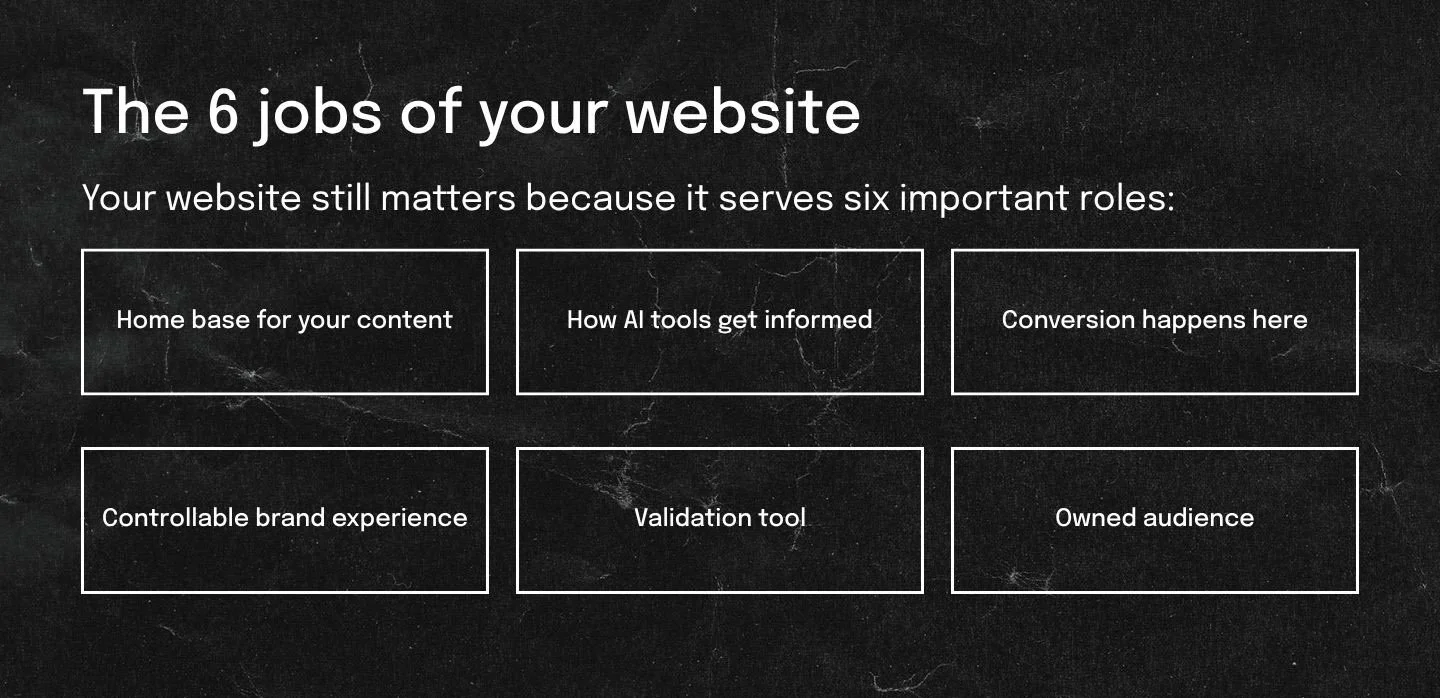
Home base for your content
Content creation is one way you provide value for your clients, customers, and prospects. Content comes in many different flavors: blogs, podcasts, videos, and art. But the main role of content is to share your unique perspective and then educate, delight, and intrigue.
Each distribution channel uses different platforms to host content, like Substack for newsletters or Instagram for social media. But none of that is owned. Your website is the number one place where you can, and should, host your content. Not only does this positively impact your website's performance, but it's a way for you to curate a brand-specific experience and invite your audience into your world. As a non-brick-and-mortar company, this is not just important; it’s part of your responsibility as a business.
How AI tools get informed
Every time your audience is looking for information via Claude, ChatGPT, or some other AI chatbot, these tools scan the web to find the answer. Those answers come from your content. Your landing pages, blogs, FAQs, and all the other content you create are what it pulls from. And most importantly, it not only provides an answer, but it also teaches AI exactly how to answer.

For example, say you own a consulting firm called Bowie Ops, that helps growing SaaS companies fix their messy internal operations. If your website says, “Bowie Ops provides operational consulting services for growing businesses. We help teams improve systems, workflows, and efficiency.” AI may interpret that as, “Bowie Ops is a business consulting company that helps growing companies improve internal processes and operational efficiency.”
Technically, it’s correct. But it’s generic. You have to give AI more to work with to get the answers you want your audience to see.
So, now you change your website content to say, “Bowie Ops helps B2B SaaS companies between $5M and $50M in revenue fix the operational chaos that comes with rapid growth. We specialize in cross-functional workflows, RevOps alignment, team accountability, and scalable systems. Unlike traditional management consultants, we work alongside internal teams to implement the systems we recommend.” AI now has enough context to provide an in-depth answer when someone asks what your company is about.
The difference here is that you’re not just giving AI facts; you’re teaching it:
What category you belong in
Who you serve
What problems you solve for
How you’re different
What language to associate with your brand
The impact? Being referenced or talked about in the spaces that you don’t own (aka everything outside of your website) in a way that you’d like to be talked about.
Conversion happens here
Unless you’ve got a rack of shirts in a cute little shop in a trendy neighborhood, people need somewhere to interact with your business and actually buy what you sell. That’s still one of the most important jobs of your website.
And it doesn’t really matter what your sales process looks like. Maybe it’s a three-month courtship involving demos, proposals, and multiple stakeholders. Maybe someone can hand over their credit card and start using your product five minutes later. Either way, you need a place where that transaction ultimately happens.
Your website isn’t just a place for people to convert. The experience itself can do a lot of the selling for you. Design, copy, navigation, testimonials, demos, and other proof points all work together to build trust, answer questions, and move someone closer to a purchase.
That level of control is hard to replicate on any other platform.
Controllable brand experience
Think about your favorite restaurant. Every detail of that space has been intentionally chosen to create a specific experience. The lighting, music, scents, furniture, art, service, menu, and even the type of crowd it attracts all work together to evoke very specific emotions.
When done well, that experience sticks with you. You don’t just remember the food. You remember how the place makes you feel, and that feeling is a core ingredient that makes you crave going back. It doesn’t matter whether we’re talking about Chipotle or a Michelin-starred restaurant. Those details are all extensions of the brand.
For businesses that don’t have a physical space that your customers can just walk into, your website becomes the environment you get to curate. It’s one of the few places where you get to control how people experience your brand from beginning to end.
CASE STUDY
Transformative Health & Wellness is a mental wellness practice based in Corvallis, Oregon. To connect with the people they serve, we built the brand around something their audience knows intimately: life in the Pacific Northwest.

Visually, the brand is moody, dark, foggy, and atmospheric. It reflects the landscape of the PNW, but it also mirrors what mental health struggles can feel like internally: heavy, unclear, isolating, and difficult to see through. The language aligns with that. Rather than relying on clinical jargon, we used poetic, reflective copy designed to make people feel seen and understood.
The result is a brand that feels distinctly rooted in the culture and environment of the Pacific Northwest; not a mental health brand that could exist anywhere.
And that distinction matters. Most of their local competitors lean into the traditional clinical aesthetic: bright white spaces, sterile messaging, and websites that center the practitioner's credentials.
Transformative does the opposite. The brand centers the person walking through the door and creates an experience that feels human long before they ever book an appointment.
The placement of buttons, imagery, colors, copy, navigation, and content all melt together to shape how someone feels while they’re there and what they’ll remember when they leave. And the way you interact with them before, during, and after the sale completes that experience.
Validation tool
If you’re a responsible business owner, you’ll know it’s important not to live on just one channel. If you’re creating content on a channel where your audience doesn’t predominantly live, it will feel an awful lot like hosting a party that no one is ever going to show up for. Which stings.
While people are learning about you and learning from you on LinkedIn, Reddit, YouTube, a podcast, ChatGPT, or in a Google AI overview, they need a place to go to validate and verify what they’ve heard. Are you really who you say you are? Do you really do what so-and-so said you do? Your website is your ultimate validation tool outside of word-of-mouth and referral marketing.
Because of this, you better make sure how you present yourself across each channel is consistent, including your site. Inconsistency is where trust goes to die.
Owned audience
Zero-click marketing doesn’t make your website less valuable. If anything, it makes the channels you actually own more important. When people are discovering your brand through AI search, social platforms, podcasts, Reddit, YouTube, or other third-party channels, you’re building awareness in places you don’t control. Algorithms change, platforms evolve, and audiences can disappear overnight. Your website gives you a place to turn that borrowed attention into something you can keep.
This is where you capture email addresses, build remarketing audiences, understand what people are actually doing once they arrive, and create a direct relationship with potential customers. The behavioral data that you get — pages someone visits, what they click, where they drop off, what content they care about, and what ultimately leads to conversion — gives you insight you simply can’t get when someone only interacts with your brand on someone else’s platform.
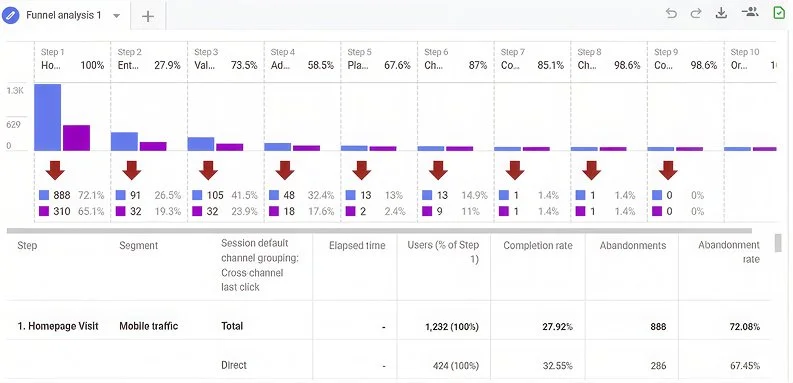
GA4 enables a sophisticated analysis of site traffic that you don’t get on rented channels
The goal isn’t to force every interaction back to your website. It’s to make sure that when someone is ready to go deeper, you have a place designed to capture that relationship. The more of your audience you can move from rented platforms into the channels you own, the less dependent you become on whatever algorithm happens to be calling the shots that week.
Signs your website is working
You’ll want to measure traditional website metrics like sessions, new users, key events, per-channel breakdown, and others. They’re valuable signals, but they’re only meaningful when viewed in the context of the bigger picture.
A dip in traffic doesn’t automatically mean your marketing is failing, just as an increase in traffic doesn’t necessarily mean it’s working. What matters is how those metrics connect to broader signals like brand awareness, lead quality, conversions, search visibility, and revenue.
The real question you should be asking yourself is whether your site is doing its key jobs. You’ll know things are trending positively if the following are happening:
Conversion rate is healthy
Owned audience is growing through email capture
AI is regularly citing your pages to inform answers about your brand (in the way you want)
You're getting positive feedback on the content and brand experiences you offer visitors
If all of the above is happening, then your website is doing its job, and you should probably go celebrate.
AI may build your site fast, but it doesn't build it well
Sites that do their job and drive revenue are usually not built in a day. And while AI tools like Lovable and Claude Code make it possible to build websites in minutes, that does raise a different question: What does a five-minute website communicate to the people you’re trying to impress?
And listen, we all have to start somewhere. If you’re a solopreneur on a bootstrapped budget just trying to survive, do what you gotta do, boo. But for the rest of us, we have to do better. Buyers can sniff out if something was AI-generated, and it smells like bullshit and a lack of genuine care. Your prospects may not know exactly which AI tool you used, but they recognize the look: same layouts, same vague copy, same overly polished imagery, same handful of design patterns. It all just blends together
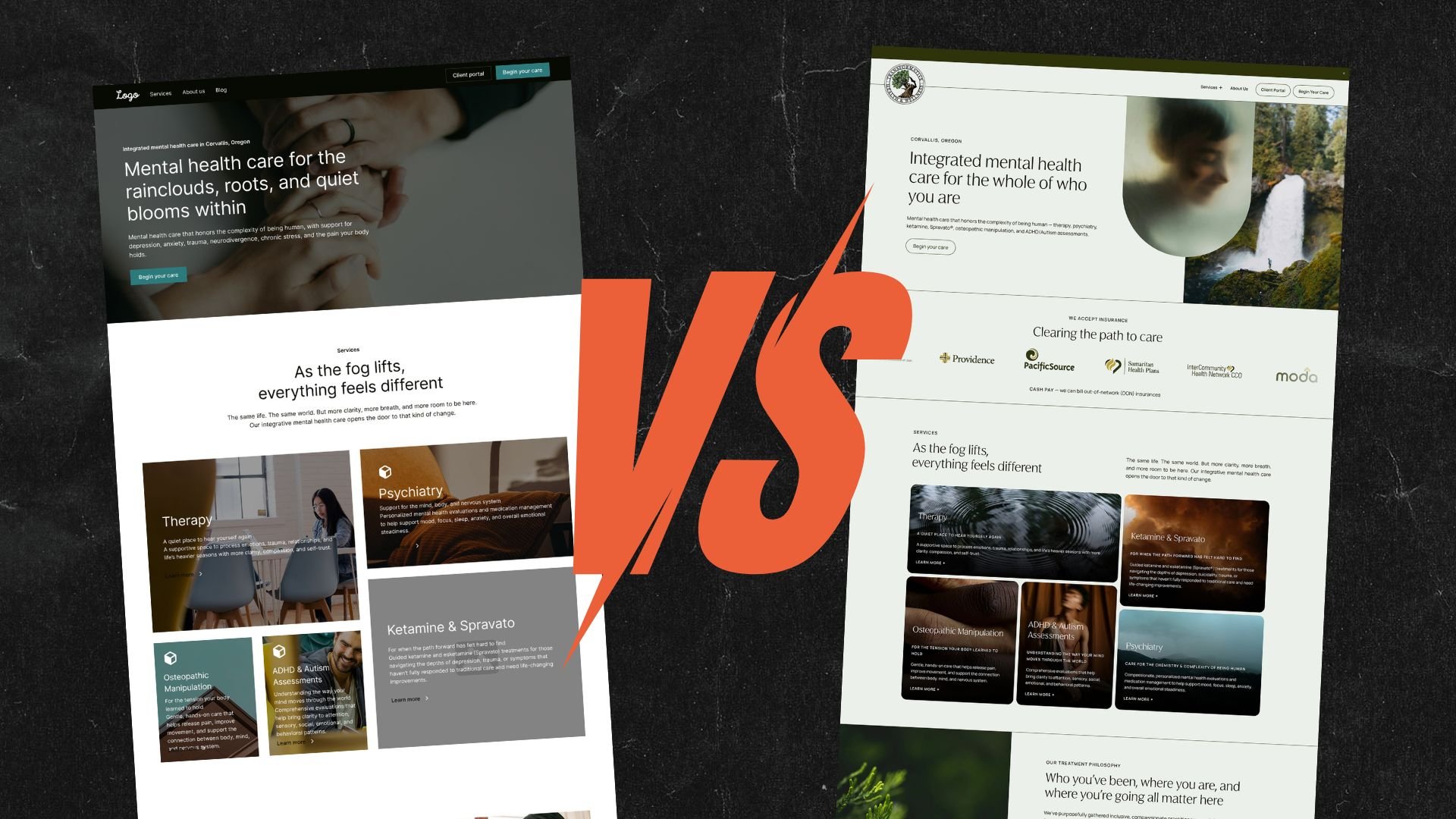
Vibe coding vs. custom design
The barrier to creating something generic has disappeared. A decent-looking website used to require time, money, and expertise. Now almost anyone can produce one in an afternoon. That means a clean, functional site is no longer much of a differentiator. If anything, it’s the baseline.
As AI makes it easier for every business to look competent, the advantage shifts to the companies that feel distinct. That is why, at Fan Club Brands, we focus on creating human-designed, artful, tasteful, distinct websites rooted in a brand strategy that's as relatable as it is provocative.
Our process is an intricate dance between strategy, design, copy, and technical optimization. It’s not something you can replicate with a single AI prompt.
We perform a technical audit and competitive analysis
We use research tools to find where your audience spends time
We use those insights to develop a differentiated brand strategy and visual identity that brings it to life.
We map your website architecture and user experience
We write the copy and design
Finally, we optimize the site for SEO and AEO
One of our clients, Sparktoro, got to experience this very process during their most recent rebrand and reimagining of their website and product. Watch this video to hear Rand talk about the process and why differentiation is so important.
The center of your marketing universe moved
It may feel scary to see traffic dip even after you have done everything right. That doesn't mean your website is dead. Your website-as-the-center-of-your-marketing-universe is.
Discovery happens everywhere: ChatGPT, podcasts, LinkedIn, Reddit, YouTube, referrals, and Google. By the time someone reaches your website, they may already know who you are and what you do. Your website’s job is to bring those interactions together: validate what they’ve heard, deepen the brand experience, show what makes you different, and help them decide to work with you.
The goal now isn’t to fully recover traffic but to build a website that does its new jobs exceptionally well. It should teach search engines how to understand your company, host the ideas and content that make you worth discovering, turn borrowed audiences into owned ones, create a memorable brand experience, and make it ridiculously easy for the right people to take the next step.
And when every business can prompt a website into existence, the advantage is no longer a decent website itself. It's the unmistakable feel and design grounded in a clear strategy and a distinct POV. A site built with thoughtful design, compelling copy, and a user experience that helps sell what you do.
That’s the kind of website we build at Fan Club Brands.
If your website still feels like it was built for the old marketing universe, it might be time for a new one. Get in touch with Fan Club Brands and let’s build a website worth finding, remembering, and choosing.